
Pachinko
How big is the pachinko business in Japan? Well, at its peak in the 1990s it employed a third of a million people, three times more than the steel industry; it commanded 40 percent of Japan's leisure industry, including restaurants and bars; and with almost 30 million regular enthusiasts coughing up more than ¥30 trillion a year (a higher turnover than the car industry), it was very big business indeed. So big, that foreign businesses got in on the act.
While much of the pachinko industry has long been controlled by residents of Korean descent, in early 2001 British company BS Group bought a stake in Tokyo Plaza, who were running about 20 parlors in Japan, and had also opened parlors in the UK.
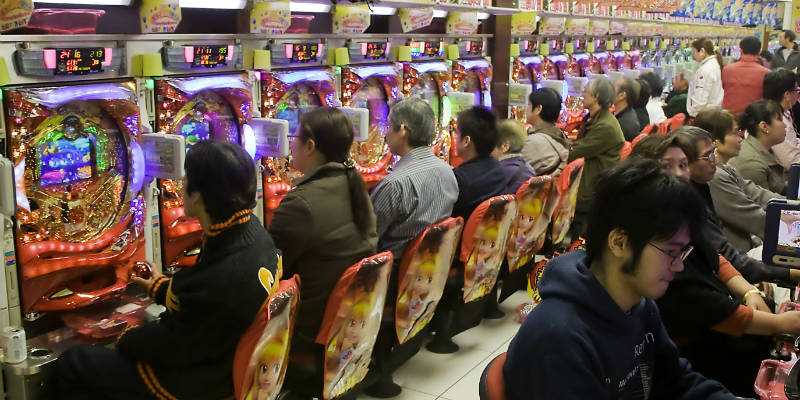
A typical busy pachinko parlor, although not as smoke-filled as they were in the past.
Since that peak, the numbers have declined significantly. In 2014 sales figures were below ¥20 trillion and there were about 10 million regular users. And of course these days there are growing numbers who are playing pachinko online, though there are few options if you don't understand Japanese. We have a feature article for anyone who ever wondered about the difference between pachinko and slots.
If you want to play pachinko in Japan you won't have to look very hard to find a parlor. There's usually at least one near every train station and where there is no station (ie. in the countryside) just look out for the ugliest, most tasteless building you can find. That's it - the big silver box in the middle of nowhere covered in neon signs and flashing lights. As soon as you step up to the electric doors and they slide open, the noise - and usually the smell - hits you.
This is not a place for casual conversation or requests for the no-smoking section. The wall of noise might seem unpleasant to the newcomer but it seems to help the serious gamblers, or pachi-puro, to concentrate, or perhaps to just switch off as they sit in silence in front of their chosen machines. Sometimes they're there all day - it's common to see people lining up outside a parlor first thing in the morning, waiting to get the machine they think is going to pay up and almost as common to see them come out in the afternoon or evening having won - or lost - a day's pay or more.

A typical pachinko machine. The balls are fed into the machine using the green handle on the bottom right.

A close-up of the playing area of a digital machine. This one is called "Go-go Akko-chan" and is named after Wada Akiko, a popular TV personality.

The entrance to a small urban pachinko parlor in Saitama Prefecture. Parlors in rural areas can be many times larger and garier. Signboards outside announce the arrival of new machines or promo campaigns.
The first thing you do is use cash or these days increasingly a prepaid card to buy a tray of what this game is all about - balls. Small steel balls, resembling ball bearings, to be exact (you can often spot the pachi-puro by the ball or ¥100 coin forgetfully left wedged in their ear). You'll pay about ¥4 per ball and while you can buy just ¥100's worth, no serious gambler would start by spending less than a few thousand yen. A variation on pachinko that has become very popular recently is pachislo, which is a combination of pachinko and slot machine and uses coin-like coupons.
Pachinko is played on what looks like a vertical pinball machine. The steel balls are released into the machine and fall through a maze of nail-like pins. The idea is to get the balls to fall into slots where they accumulate and to aim for jackpots, which pay out thousands more balls. There are three main types of machines with different levels of skill required. In the oldest style of machine, the positioning of the pins greatly affected the payout so they would be tapped into minutely different locations by specialists each night after closing - hence the morning queues for the best machines.
These days the more popular deji-pachi (digital pachinko) machines have an LCD display in the center showing colorful animations that indicate your jackpot, or "fever". The noisy animations often feature popular cartoon characters or hentai (erotic) anime. Computer settings are only adjusted every few days so the pros watch out for the big payers. The winnings that you're aiming for are actually the same balls that you put in, hopefully multiplied a few times. They usually have a cash value of about ¥2.5 yen.
Though the win ratios are set by the government, parlors are believed to often manipulate them such as by increasing jackpots on busy days to draw people back again. On the other hand, resourceful players resort to using ingenious electronic or magnetic devices to try and hotwire the digital machines into making big payouts. Parlors are not legally allowed to actually pay out cash. So you take your trays of balls and exchange them for prizes like washing powder, cigarettes and brand goods or tokens that can be cashed in at a nearby hole-in-the-wall. Similar to cashing in your chips at a casino except for the fact that it's a flagrant manipulation of the law. These places then sell the tokens back to the parlor, with their cut on top.
In addition to pachinko, most parlors also over a range of pachislo games. Similar to the American equivalent of slot machines, players exchange cash for tokens which they then insert into the machine. The game starts when a small lever is pulled, but unlike classic slot machines, you press buttons to stop the reels, adding an element of skill to the game. With pachinko each steel ball is the equivalent of about ¥4, whereas pachislo tokens are valued at approximately ¥20.
Japan's long economic downturn did not stop people from playing pachinko. Indeed economic desperation forced many to turn to gambling as a last resort. But changing attitudes and lifestyles have eroded the customer base and forced companies to try to attract new kinds of customers. Leading machine maker Sankyo has employed Hollywood star Nicholas Cage to appear in a series of TV commercials where he played a pachinko freak. Parlors with bars and cafes, women-only sections, fountains and luxury furniture are just some of the other ideas for bringing this Japanese way of life into the 21st century.