
Manga
To many Westerners, one of the hardest things to understand about the Japanese is their voracious appetite for manga or comics (though the recent launch of an English version of Shonen Jump manga in the US was hugely succesful). In particular, the fact that middle-aged men can sit with their heads buried in comic books on rush-hour trains without any sense of embarrassment. While in the West mainstream comics are almost entirely for children, in Japan there many types of manga and some of them are very definitely NOT suitable for children. Graphic violence and sex (but with restrictions on the visibilty of actual organs) have been commonplace in manga for years. A law introduced to curb child pornography (most of the world's supply being from Japan) for some reason excluded manga - probably something to do with it being a ¥500-billion-a-year industry.
Manga come in two main forms: weekly, twice-monthly and monthly magazine style manga and paperback books, usually in a series. These series often spin off from the magazines and in turn are made into TV shows or movies. For some examples, see the sections on Animated movies and TV cartoons.
 Mangajin was a classic magazine that used manga as a fun and effective way to learn Japanese. Published between 1990-97, it also included interesting features on various aspects of Japanese culture. It's now out of print, but back issues are still available from Wasabi Brothers. Your support might even help them in their efforts to revive one of the best magazines to come out of Japan.
Many manga carry full-color advertisements for muscle-building devices and pheromone sprays. As you might have guessed, most manga are geared toward shonen (young guys). But there are also shojo (young girl) manga. They deal mainly with science-fiction, sports and romance and tend to portray male characters as stereotypically as the guy's manga do with female characters. A popular girl's manga is Sailor Moon, which also became a successful TV show and several movies. Naturally, they're popular with girls but also with a certain number of boys and young men. This and the popularity of animated porn is, I'm afraid, beyond my understanding. Suffice to say that the world of manga and anime (animation) is huge in Japan and beyond and there are countless Web sites dedicated to it.


Margaret (left) and Sailor Moon (right) are popular shojo manga.
Evangelion (above) was hugely popular in 1997.
Most weekly manga are the thickness of a telephone book. Even though they are printed on recycled paper, the price of around 200 yen seems ridiculously cheap. But with weekly sales in some cases of over five million copies and the most popular stories going on to become paperback collections, TV cartoons or dramas and even full-length movies, manga are very big business. Just two examples are given below.
Shonen Magazine
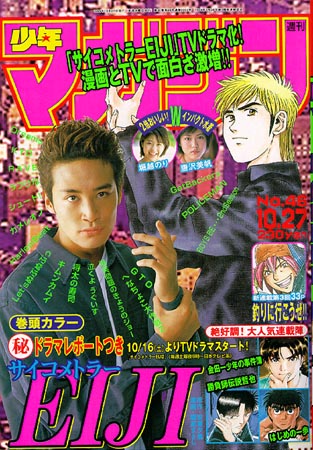
One of the pioneers of the fat shukan manga (weeklies), along with Shonen Sunday, Shonen Magazine debuted in 1959 and is still one of the most popular boy's manga (shonen means young boy). With over 200 pages and a cover price of 230 yen, it seems like pretty good value. All the stories use kana (phonic) characters next to the kanji (Chinese characters), which makes them readable for the younger or less literate Japanese and useful for students of the language. As well as the manga stories and advertisements, the magazine has full-color photo spreads of a couple of teenage bimbos, usually in bikinis and with a contact address for fan-mail. The October 27th, 1999 issue (right) includes the mangas GTO (Great Teacher Onizuka), which has been made into a TV drama and a movie, and Psychometora EIJI, made into a TV psycho-drama starring heartthrob Matsuoka Masahiro. Other subjects include soccer, fishing and sushi, while with some of the manga it's hard to tell what exactly they're about.
The magazine is published by Kodansha, who also publish a variety of other magazines in six categories: General/Men; Women; Children; Literature/Arts; Comics for Men; Comics for Women.

Click for larger format (87k)
Shukan Shonen Jump
Launched in 1968, Jump tried to do things differently from the start. In order to compete with the already successful Shonen Magazine and Shonen Sunday, Jump concentrated on hiring and hanging onto talented but as yet undiscovered cartoonists and keeping a close eye on what its readers wanted, through surveys and polls. This approach helped Jump become by far the biggest manga in Japan with sales as high as six million copies a week. Its most successful series have been spun off to create TV cartoons, movies and video games including Dragonball Z and Dragon Quest which have been hugely popular both in Japan and abroad. Other huge domestic hits include Kinnikuman (Muscle Man) and Slam Dunk, which capitalized on the NBA craze of the early and mid-90's.
The publisher of the manga, Shueisha has dozens of other publications, including Ultra Jump, Business Jump, Young Jump, Monthly Jump etc and women's manga like Margaret, Young You and Ribbon and magazines such as the Japanese editions of Cosmopolitan and Playboy.

Click for larger format (24k)

Related links:
- Check out our background info on anime, anime movies, TV anime and selection of Japanese movie posters.