
Bonsai - Trees in Miniature
What do you do when you live in a country with limited space but want to exercise your green fingers or express your love, and even your spiritual reverance, for nature? Well, you can always do things in miniature - ikebana and bonsai are your two main options. Though the word 'ikebana' literally means 'living flowers', it is actually the visual presentation of cut stems, flowers and other features to represent an aspect of nature in miniature. Bonsai, on the other hand, means 'pot plant' and the art form involves raising living trees, often over a period of several years. While they are small, bonsai are not actually different from the trees we see around us, they are not miniature species. Rather they are small branches of a tree, carefully chosen, pruned and cultivated so that they look like smaller versions of their own species. They are also displayed in a way that shows off their best features, usually in a simple, shallow pot. Bonsai is about the combination of the plant and the pot. There are many different styles of bonsai such as: broom style - a tapered trunk topped by a symmetrical area of foliage; cascading style - the pot is kept on a platform and the branches 'cascade' down below it; windswept style - resembles a tree that has grown up in an area exposed to strong winds. Saikei is similar to and often confused with bonsai, but is actually closer to ikebana. Different species of small trees as well as other plants, rocks and sand are used to create miniature landscapes.
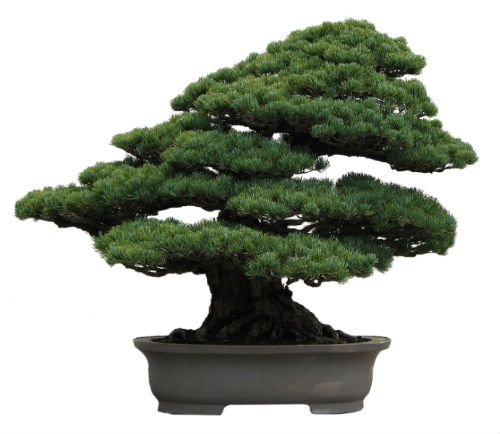 Gardening in many forms has been enjoying something of a boom in Japan in recent years and those with limited space have been rediscovering the charms and challenges of this part of their native culture. As I said, bonsai are real trees in miniature and are not usually suitable as houseplants (some species have been developed for indoors). Usually they are hardy and can handle most weather. In fact, their growth may be adversely affected by artificial (ie. indoor) light and heat conditions, depending on your climate and the origin of the tree species. Even a small city apartment balcony can be big enough to build up a collection, something of an oasis for many urban dwellers. The smallest of bonsai, called mame (bean) can be just a couple of inches tall and a collection may also have trees a couple of feet high. The most popular are about 6 inches to a foot.
For the more serious gardener, it is possible to grow bonsai from seeds, cuttings, a branch while it is still on a living tree or even prune and adapt a tree from a garden center. But these are long and laborious processes, taking several years before you have any kind of 'finished product'. Indeed some of the most prized bonsai have been around a lot longer than their owners. Some enthusiasts go to great expense to buy bonsai from dealers but if you just want to dabble or test the waters, it is possible to start off with a good guide book and a domestic plant (cheaper than imports) from a hobby or gardening shop for just a few thousand yen. I watched a program on TV last night where bonsai amateurs had to guess the values of various high-quality specimens. The most expensive looked similar to the one in the photo above and was valued at over 5.5 million yen (almost 50,000 dollars!). Special qualities that made that particular specimen so valuable included the unusual (for the species) thickness of its trunk and branches and its old age.
What makes a bonsai? (courtesy of The Bonsai Primer website)
A bonsai may be developed from any woody plant (tree or shrub), however you should bear in mind that:
- A bonsai is the tree and the pot.
- The trunk is what gives the tree its "stature", poor trunks make poor bonsai. Ideally the trunk should have a good taper, with a good root formation visible at soil level.
- Bonsai have larger branches at the bottom of the tree, the branches decrease in size as they get nearer the top of the tree. The distance between the branches decreases the nearer the top of the tree they are.
- There should be "negative" (open) areas between the branches, this gives the impression of a tree rather than a shrub.
- A bonsai may have areas of dead wood to give an impression of age.
Related content: