
Noh Theater
Noh is the oldest existing form of theater, and though it can seem very inscrutable and - let's admit it - boring, it has enjoyed something of a revival recently in Japan. The main reason has been the growing popularity of a new young generation of stars. Most visible among them have been Izumi Motoya, often refered to as the Prince of Noh, his sisters Junko and Miyake Tokuro, and Nomura Mansai. Izumi Junko was the first female Noh performer ever and obviously attracted a lot of attention. Nomura played the lead in a popular period movie Onmyouji (2001), set in the Heian Era.
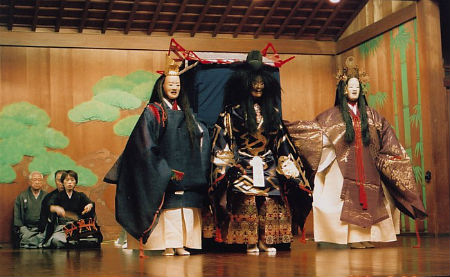
Center stage in a noh play
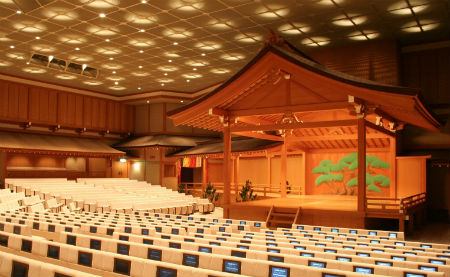
A typical noh theater
Noh grew during the 14th century out of combination of Chinese performing arts, known as sarugaku, and traditional Japanese dance called dengaku. Acting troupes were under the patronage of shrines and temples and their performances were as much 'sermons' as entertainment. Noh's present form dates from around the end of the 14th century when the main playwright/actors were Kannami and his son Zeami. Having performed for the Shogun Ashikaga Yoshimitsu (1358-1408), they received his sponsorship and reached a higher social status than actors had ever achieved. Zeami wrote many plays which are still performed today, including the classics Takasago and The Well Curb (Izutsu) and his ideas on zen and theater form the very basis of noh. In a sense, noh represents the austere Buddhist way of life adopted by the aristocracy, while kabuki represents the more earthy, animistic Shinto philosophy.
During the century of civil war (1467-1568) the shogunate had little time for cultural distractions but the rest of the populace embraced them. Noh, together with other art forms, the tea ceremony and Buddhism, spread throughout all levels of society. When peace returned, so did the patronage of the Shogun, this time with renewed enthusiasm. Hideyoshi and later Ieyasu celebrated their coming to power with noh performances.
In an effort to keep noh as the exclusive property of the aristocracy, commoners were forbidden to learn the music and dance of noh. But toward the end of the Edo Period (1600-1868), as the military class began to lose their grip on power, noh and kabuki became increasingly popular among the people. Government subsidy stopped with the fall of the shogunate in 1867 and members of the nobility assumed the role of sponsor. Although it suffered as a result of the reforms carried out during the Meiji Period (1868-1912), it maintained enough support and private sponsorship to survive and even flourish.
Most performances are indoor but the stage (butai) retains its original, outdoor design complete with pebbles and small pine trees. In a typical scene, the shi-te is the principal actor (center stage), supported by a companion, the tsure (stage left) and a secondary actor, the waki (far right).
The performance is accompanied by three or four traditional musical instruments, such as the tsuzumi drum and shamisen, and a chorus of six or eight people. Each performer has his prescribed place on the stage. The progress of the play can be determined by the positions of the two main actors.
The character of the main actor is created with a combination of masks and elaborate costumes. He is the last to arrive on the stage, appearing from the darkness and entering along the hashigakari, or bridge behind the main stage. He wears at least five layers of clothing, creating a larger than life presence. Often, he will change his mask mid-performance to reveal his true self. Scenery is practically non-existant but props play an important role. Chukei (folding fans) in particular are used to represent objects or to express actions. The performance is a combination of song, dialogue, music and dance. Both classical prose and poetry are used and are beyond the comprehension of most Japanese. But, as in kabuki, the story is already familiar to the audience and the it's the atmosphere and underlying aesthetic that is important.

A noh actor wearing a hannya mask

A kyogen performer
Kyogen
During the interval, and also between individual noh plays, there is a half-hour kyogen performance. These performances vary - some serve to explain in simple terms the story of the noh play, others simply offer some comic relief. Kyogen is actually an elaborate art form in itself but is most often considered a part of noh.
There are five types of noh plays and traditional programs include one of each, in order. They feature the following characters: gods, warriors, beautiful women, various figures (often modern figures or crazy women!) and finally demons. The most popular play in the noh repetoire is Lady Aoi (Aoi no Ue), which is based on events from the famous 11th-century novel Tale of Genji.
As with kabuki, noh may be hard to handle in its full format. The performances are very long, although they are broken up by the occasional kyogen sketches. The word noh actually means ability or skill and you'll need plenty of it to get to grips with a full performance! If you're lucky enough to catch a (relatively short) noh performance held outdoors somewhere in the country on a balmy summer's night with flaming torches for lighting, it's actually quite an experience. The eerie masks really come into their own and almost seem to come alive. And believe me, children will not thank you for making them spend any time whatsoever in the company of one of those 'hannya', or female demon, masks (left). They do make great souvenirs, though.
Related content: