
Age Gap Relationships in Japan Between Tradition and Modern Dating
September 7, 2026
The age difference between Japanese husbands and wives has been shrinking for 60 years, and the reason has almost nothing to do with changing romantic taste. It is a byproduct of how people meet. When families and companies did the introducing, they produced older grooms and younger brides as a matter of routine. When that system faded, so did the pattern it manufactured, and the numbers moved without anyone deciding they should.
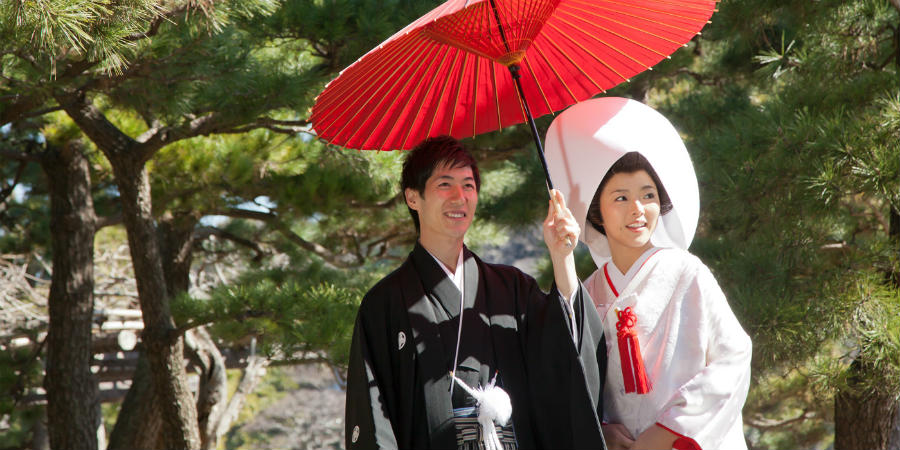
A Japanese bride and groom in wedding kimono.
Historical Precedent in Omiai
Until the 1940s, roughly 70% of Japanese marriages were omiai, the formal introduction system whose name translates as looking at each other. The practice began as an alliance between families, most rigidly among the samurai class, and softened by stages into a parental recommendation and then into a supervised introduction that either party could decline.
Love marriages overtook the introduced kind in the mid-1960s. Omiai itself never disappeared, and by the end of 2022 it still accounted for about 15.4% of marriages annually, which is a larger share than most Western observers assume.
The relevant detail for age difference is what the old system optimized for. An introduction was built around an established man and a younger woman, because the man's earning position was the qualifying criterion and it took years to reach. Remove the introduction and you remove the mechanism that produced the gap.
Current Marriage Statistics
Couples where the husband is older have dropped to under 60% of all Japanese marriages. Couples where the wife is older passed 25% in the early 2000s. Both movements track the decline of omiai closely enough that demographers treat the two as connected.
The average age at first marriage has climbed past 31 for men, with women a year or two behind. Marriages fell below 500,000 in 2023 for the first time since 1917, then recovered slightly to 485,063 in 2024.
The birth figures are steeper. Japan recorded 686,061 births in 2024, down 5.7% from the previous year, with the fertility rate at 1.15 against 1.2 in 2023. The population fell by roughly 919,000 people, the 18th consecutive annual decline.
The Modern Vocabulary of Partnership
Naming what you want has become normal in a way it was not two generations ago, and the vocabulary differs by market. In English-speaking countries a person might say plainly that they are looking for a sugar daddy, or that they want a partner 20 years older. The words are local, and the willingness to use them travels.
What used to be settled quietly is now stated out loud at the start. An age difference between two people is one more item in that vocabulary, and no more remarkable than the rest of it.
Government Intervention in Matchmaking
The state has taken over a role that families and employers used to fill. Prefectural governments run subsidized introduction services, and the national government has expanded its involvement steadily. Officials acting as romantic matchmaker is a development without precedent in Japanese history, and demographers are largely unconvinced it will change the trajectory.
Tokyo went further in September 2024 by launching its own application, built on the finding that around 70% of people who said they wanted to marry were not dating anyone. Letting AI play matchmaker required applicants to prove they were legally single and pass an online interview first. By June 30, 2026 the service had 16,000 members drawn from about 36,000 applicants, with 760 couples reporting serious relationships and 265 marriages recorded.
What the state cannot reproduce is the part of omiai that mattered most, which was a third party with standing to insist. A prefectural database can introduce two people. It cannot apply the pressure that made the old system work.
Work Culture and Marriage Timing
Hours are the constraint everyone in Japan names first. Almost a quarter of Japanese companies had staff working more than 80 hours of overtime a month according to a 2017 survey, and much of it was unpaid. Karoshi, death from overwork, has its own vocabulary and its own government white papers for a reason.
The policy response has been to attack the schedule directly. Tokyo now offers a 4-day week to its own government employees, and the private-sector precedent most often cited is Microsoft, whose Japanese offices closed every Friday in August 2019. That four-day work week produced a 40% rise in sales per employee against the same month a year earlier, and 92% of the participating staff rated it positively afterward. The hope behind all of it is that people with free evenings will use some of them to meet each other.
This connects back to age difference in a specific way. A man whose career consumes his twenties and early thirties enters the market later than the women his age who have already married, which mechanically produces gaps at the point of marriage even when nobody was aiming for one.
Attitudes Among Younger Adults
Nearly a fifth of Japanese men and about 15% of women now say they are not interested in marriage at all, the highest readings since 1982. The commentary around this has been running for over a decade, with foreign outlets repeatedly reporting that young people in Japan had given up on sex and partnership altogether, a framing that generated far more attention abroad than agreement at home.
Conditions explain more of this than preference does. Wages stagnated through the 1990s and never fully recovered, women entered the workforce in numbers, housing near employment stayed expensive, and the social penalty for staying single fell away almost entirely in the cities. Marriage became one option among several instead of the default schedule, and options get exercised at very different ages than defaults do.
For couples with a wide age difference, the effect is mixed. Public comment has softened considerably, since a country where a fifth of men opt out entirely has limited energy for policing who married whom. Family expectation has held up better than the surveys suggest, particularly outside the largest cities, where a single introduction can still circulate through an entire extended family within a week.
The split is geographic. A couple 15 years apart in Tokyo will encounter almost no friction from strangers and a great deal from one specific aunt. A couple the same distance apart in a smaller prefecture will find the proportions reversed, with the family arriving at acceptance faster than the people on their street.
265 Marriages
Tokyo's application processed about 36,000 applicants, admitted 16,000, and produced 265 marriages. Against a country recording 485,063 marriages and 686,061 births a year, that is a rounding error, and it is the most direct evidence available that matching people was never the constraint.
The age gap in Japanese marriages narrowed because the institution that manufactured it stopped operating. Nothing has replaced that institution, and the fertility rate of 1.15 is what the absence looks like on a chart.
Related content